When Async becomes Always-On
A peculiar ritual plays out in the recruiting process of many large tech companies. The job description mentions flexible hours. The hiring manager speaks enthusiastically about remote-first culture. The onboarding documentation devotes entire sections to asynchronous communication principles. And then, somewhere around the second week, you notice that everyone responds to Slack messages within minutes, that the calendar fills up with daily syncs framed as optional but attended by everyone, and that the senior engineer who went offline at six PM is quietly discussed the next morning.
I have been through this more than once. The specifics vary, the script does not.
The disconnect between the remote-first promise and the sync-heavy reality is not a rounding error or a failure of implementation in a few isolated cases. It is a structural tendency, one that reasserts itself even in companies that have genuinely tried to do things differently, because it is much easier to change the tools and the vocabulary than to change the underlying assumptions about what work looks like and how trust is established. Some organizations spend considerable effort convincing prospective employees that they operate differently, and they are not necessarily lying. They believe it themselves. The belief just tends not to survive contact with the first deadline.
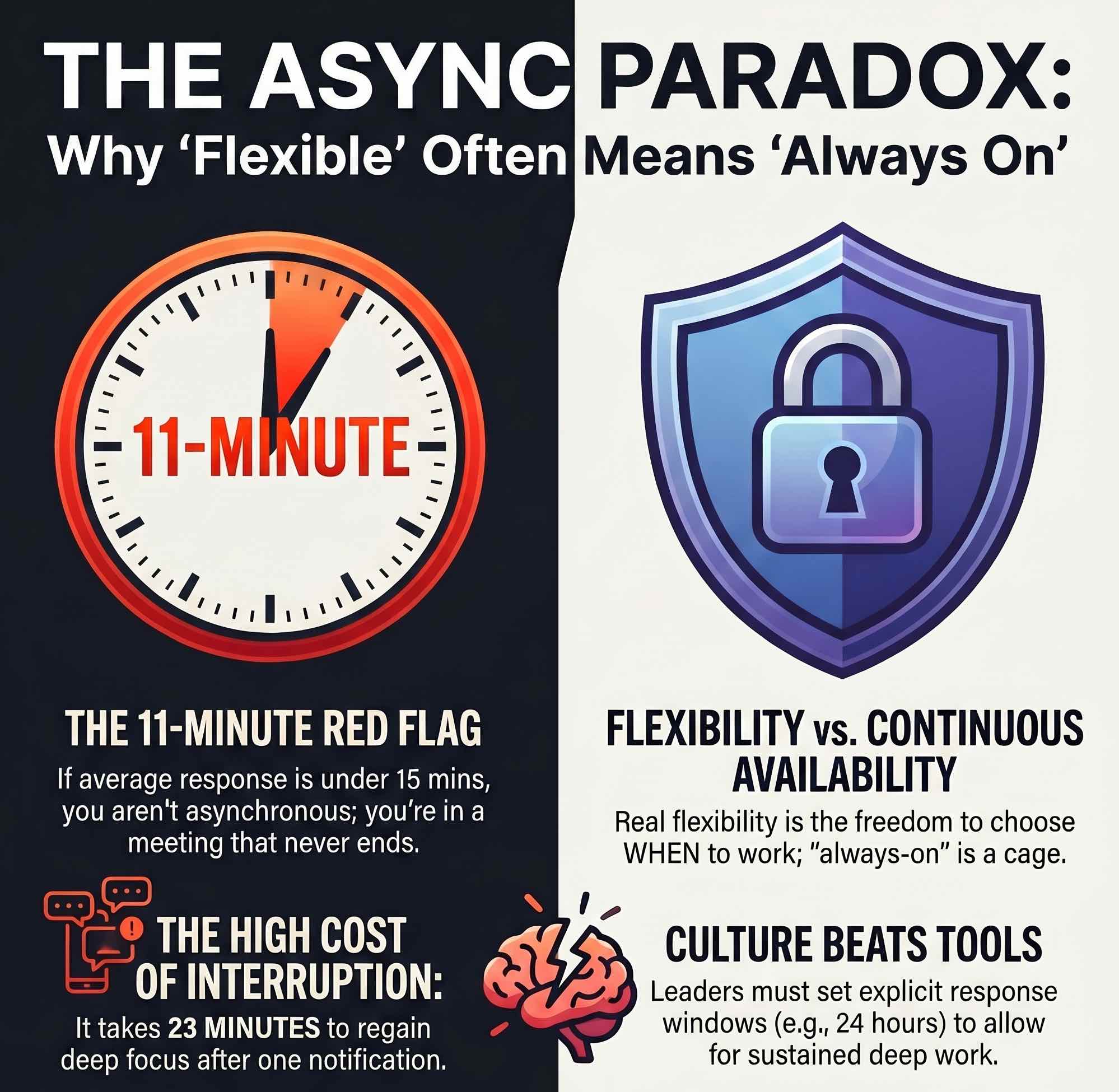
Ask any team that proudly describes itself as async-first: what is the average response time to a direct message? If the answer hovers around fifteen minutes, the label is a polite fiction. What you actually have is a permanent meeting, one that never ends and never had an agenda in the first place.
This is the paradox that most organizations avoid saying out loud. In the rush to embrace asynchronous work as a modern, enlightened alternative to the nine-to-five office, many companies have ended up with something considerably worse than the old model. They did not abandon the constant availability of traditional office culture. They simply removed the fixed schedule that used to give it boundaries.
The myth of the async-first company
The idea behind asynchronous work is compelling. Employees contribute when they are most productive, communication becomes more deliberate and documented, and the pressure of real-time interaction fades into something more humane. In theory, people stop reacting to the constant pull of an open channel and start working with real focus.
A European tech company I analyzed some time ago was a clear example of this divergence. It publicly positioned itself as async-first, celebrated the absence of mandatory meetings, and gave its employees full freedom over their schedules. The average response time to a direct message on Slack was eleven minutes.
Those eleven minutes are not a measure of efficiency. They are a measure of anxiety. The people on that team were not choosing when to work. They were glued to a chat interface all day, monitoring the stream of messages to make sure they were never the last to respond. The freedom they had been promised was replaced by a subtler form of pressure, invisible but constant, with no fixed start or end.
Many workers already know this from experience: constant monitoring and repeated check-ins erode concentration and increase exhaustion. Yet organizations keep confusing the tools of asynchronous work with the culture that makes it function.
When “flexible” means always available
Traditional office work had one structural advantage: it ended. There was a physical moment of departure, a commute that created a psychological boundary between work and the rest of life. People complained about it for decades, and many of those complaints were valid. But the workday had a last hour.
Remote work dissolved that boundary without necessarily replacing it with anything. When Slack lives on your phone and the office is fifteen feet from your bedroom, the endpoint of the workday becomes negotiable, and in practice, it often gets negotiated away entirely. Pandemic-era research on software teams found the same pressure in a different form: more activity outside core hours, blurred work-life boundaries, and a heavier meeting load rather than a cleaner separation between work and private time.
The word “flexible” became particularly elastic in this transition. For many organizations it started to mean that people could theoretically work at any time, which in the absence of explicit boundaries translated into an expectation of availability at all times. Continuous availability is not flexibility. It is a cage without a schedule. The critical difference is between the ability to choose when to work and the obligation to always be reachable, and those two things are not the same even when they coexist on the same platform.
Gloria Mark at the University of California, Irvine has documented that it takes an average of twenty-three minutes to fully regain focus after an interruption, while knowledge workers are interrupted roughly every eleven minutes on average. The math is simple: sustained deep work becomes structurally impossible when response time expectations sit below that threshold.
What managers signal without knowing it
Part of this problem has nothing to do with tools or policies. It is about behavior, specifically the behavior of people with authority.
When a manager responds to a Slack message on a Sunday evening, they are not just answering a question. They are communicating something to every person on their team who sees that response appear. No matter how clearly the company handbook states that there is no expectation of out-of-hours availability, what people observe in practice carries more weight than what is written down. Managers set the tone, and teams mirror their behavior.
This dynamic appears in every kind of workplace, but remote and async-first environments make it more acute because the signals are harder to read. In an office, you can see that your manager is working late and make a conscious choice about whether to stay or leave. In a distributed setup, the only visible artifact is the timestamp on a message, and those timestamps do not come with context. Did they send that message because something was genuinely urgent, or because their evening happened to include a few minutes at their laptop? The reader cannot know, but they will feel the implied expectation.
After-hours messages from managers are especially corrosive to work-life boundaries, and teams with little after-hours traffic usually feel more supported. The policy says one thing. The notification at 10 PM says another. Behavior always wins.
I explored this at length in a previous post on strategic disconnection as a management competency: the ability to deliberately step away from the digital stream is not an abdication of responsibility, it is one of the clearest signals a leader can send about what the organization actually values.
The always-on trap in tech culture
Technology teams are particularly susceptible to this pattern, for reasons that go beyond tooling. Engineering culture has a long tradition of treating responsiveness as a proxy for dedication. The engineer who answers fastest is seen as most engaged. The on-call rotation trains people to treat their phone as a continuous obligation. The incident channel never truly sleeps.
This logic holds in security operations and incident response, where alert fatigue and burnout are familiar professional hazards. But the logic that makes sense for a production incident, where a genuine emergency exists and real-time response has measurable consequences, gets exported into contexts where it does not belong. A question about the Q2 roadmap is not an incident. A comment on a design document does not require a fifteen-minute response window.
Remote work did not remove this reflex; it moved it into asynchronous channels. The meeting-obsessed manager who scheduled eight synchronous standups just schedules eight async updates instead. The culture of urgency migrates into threads, direct messages, and notification badges, wearing the vocabulary of flexibility while preserving the underlying anxiety intact.
The result, in many organizations that consider themselves progressive about remote work, is a kind of availability theater. People keep a window open, respond quickly, manage their read receipts, and tell themselves they are working asynchronously.
What real async actually looks like
The promise of async work is not the ability to work at midnight from anywhere in the world. That description is closer to the always-on trap than to a genuine alternative. The real promise is quieter and harder to protect: the freedom to choose when to work, combined with the equally important freedom to not work during the rest of the time.
Teams that make async work possible do it with explicit expectations rather than vague principles. Response windows are defined and differentiated: urgent issues get a phone call, routine questions get a twenty-four hour window, everything else gets answered when the person is actually working. Ambiguity about response times is treated as a design problem to solve, not as a cultural attitude to celebrate. Some teams enforce notification blackouts in admin settings, not just in the handbook, covering the hours when people should actually be unreachable.
This shift moves the problem out of the individual and into the organization. Telling people to set their own boundaries in a culture that rewards responsiveness is asking individuals to swim against a current the organization itself created. The current has to change direction first.
Boundaries in this context are not just about personal preference or work-life balance. They are necessary for sustained concentration. Sustained deep work, the kind that produces the output knowledge workers are actually hired to produce, requires protected time. And protected time requires the organization to decide, explicitly, that some hours are not available for messages.
The companies that figure this out communicate with more intention, document decisions more consistently, and trust their people to manage their own time within clear parameters. When that happens, teams usually end up with fewer scheduled meetings and more room for focused work. Those outcomes come from culture, not from deploying a new tool.
Slack is not the problem, and eliminating Slack would not solve anything. The question is whether the organization has built the norms, expectations, and behaviors that let people actually use it asynchronously, or whether it has just renamed its always-on culture and convinced itself that the rebrand was a transformation.
If your team’s average response time is eleven minutes, you already know the answer.