When risk fragments, cybersecurity strategy stalls
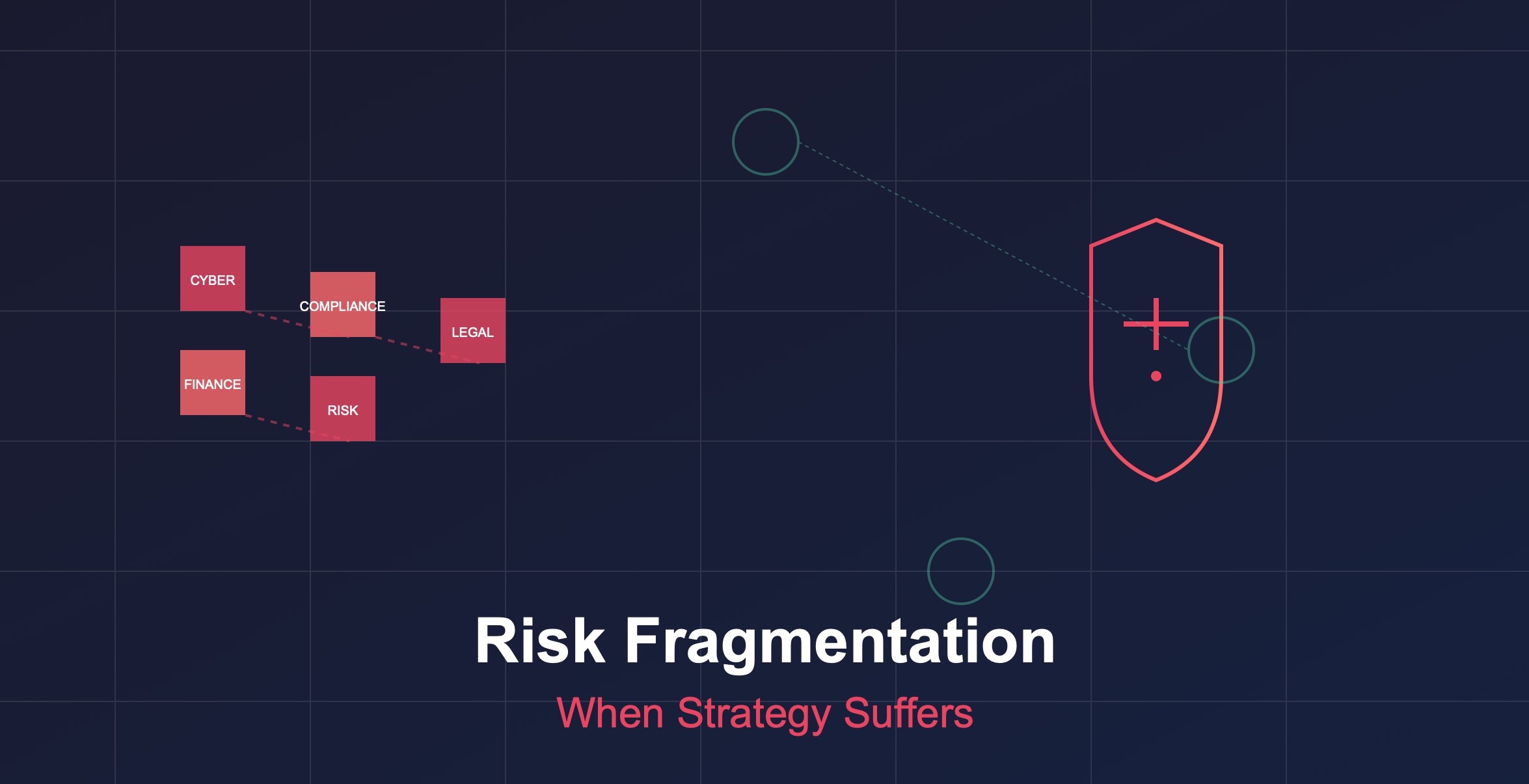
Security dashboards can look reassuring, but they can also hide a simple problem: risk information is scattered. Risk fragmentation happens when cybersecurity, audit, compliance, legal, and enterprise risk teams all produce correct work, yet leaders still struggle to decide what to prioritize and why.
In cybersecurity this matters because attacks do not stay in one lane. A single intrusion can start with stolen credentials, jump to cloud admin tools, touch regulated data, and end in extortion. If the organization monitors and governs those domains separately, it may detect isolated symptoms while missing the pattern.
The cybersecurity cost of siloed risk management
Silos are not only a management nuisance, they create technical blind spots. When one team owns identity risk, another owns cloud security, and another owns audit evidence, no single view explains how an attacker could move from an initial foothold to a meaningful impact.
The NIST Cybersecurity Framework treats security as a connected lifecycle, but fragmentation breaks that loop into separate streams. The security operations center may see weak signals early, while governance discussions arrive later, turning decision latency into an avoidable vulnerability.
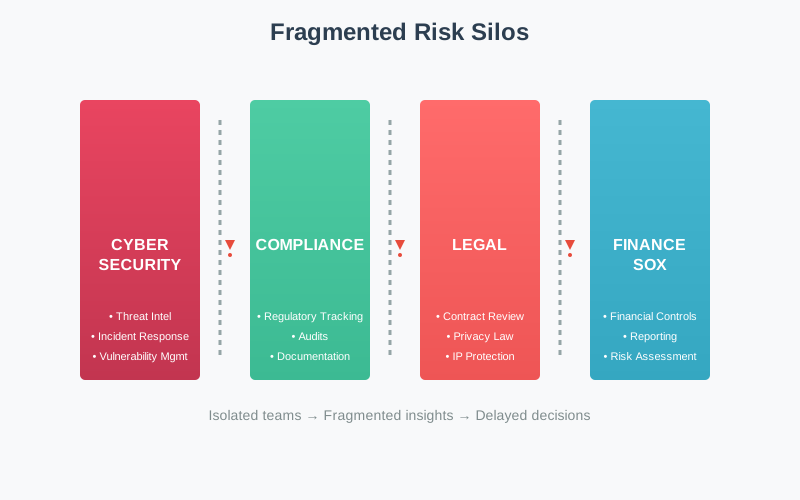
That is how vulnerability backlogs grow even with solid tooling. One team flags an exposure, another disputes the business impact, and a third asks for proof in a different format. Meanwhile, the attacker’s path stays intact.
The MITRE ATT&CK knowledge base is a useful reminder that intrusions are chains of techniques across multiple domains. In a fragmented model, defenders may spot a few steps but miss the end-to-end campaign.
Why cybersecurity frameworks fragment in practice
Most fragmentation is unintentional. Cybersecurity teams optimize for speed, compliance teams for evidence, legal teams for liability, and enterprise risk for consistency. Those priorities make sense, but they pull apart when there is no shared structure.
The gap widens because technology moves faster than governance. Security engineering can change configurations quickly, while policies and audits update slowly, creating governance lag during cloud rollouts, acquisitions, or platform migrations.
The NISTIR 8286 series offers a practical bridge between cybersecurity risk and enterprise risk management, but it is rarely used as a day-to-day operating model. Under regulatory pressure, teams often build parallel documentation pipelines that look thorough yet become hard to operate.
Strategic security decisions require integrated risk visibility
Fragmentation hurts most during big decisions, not routine operations. In a merger, product launch, or regulated-market expansion, leaders need one narrative: what could fail, how likely it is, and what it would cost to fix.
Acquisitions are a classic trap. Security due diligence might highlight weak identity governance or missing endpoint coverage, while legal focuses on breach notification obligations and contract language, and compliance focuses on data handling constraints. If those threads are not tied together, leaders can end up approving a deal with “manageable risk” in three separate memos that actually describe the same failure mode from different angles. The first incident after close then becomes a debate about ownership instead of a fast response.
Cloud transformations create similar friction. Security engineers may approve an architecture because it meets baseline hardening, while governance discovers later that log retention, privileged access review, or third-party integrations were not designed to produce audit-ready evidence. The fix is rarely a single configuration change, it is usually a set of coordinated changes across IAM, logging, and operations, which is hard to do when the risk view is split.
Disclosure expectations also raise the stakes. The SEC rules on cyber incident disclosure pushed many organizations toward faster, clearer cyber reporting, which is difficult when risks are described differently across teams.
Operational technology is another stress test. The industrial control systems guidance from CISA exists because safety constraints, long-lived assets, and fragile uptime requirements demand cross-discipline coordination. Without it, “acceptable” controls on paper can still leave real gaps in segmentation, monitoring, and response.

This is where “integrated risk” becomes practical rather than theoretical: it turns scattered assessments into decisions that can be executed, funded, and verified.
Building integrated cybersecurity risk capabilities
Integration does not mean merging teams. It means giving teams a shared backbone so their outputs connect, starting with a common vocabulary for assets, identities, controls, and business impact.
It also requires agreement on what “good evidence” looks like, especially for cloud telemetry and access logs, so the same signals can satisfy security operations and governance. That kind of alignment is boring on purpose, and it prevents late-stage surprises.
The NIST SP 800-53 control catalog is useful connective tissue because it maps across security and compliance domains. Used pragmatically, it supports one risk register that different teams can consume without translation.
Sustaining integrated cybersecurity risk management
Integration only sticks when it becomes part of how decisions are made. Threats evolve, suppliers change, and business priorities shift, so connections between risk domains need to be maintained like any other critical system.
Culture matters as much as process. When security engineers understand what auditors need, and auditors understand what responders need, friction drops and handoffs get faster. The NCSC guidance on cyber resilience helps because it frames security as repeatable practices rather than a paperwork exercise.
If risk is fragmented, strategy stalls. When risk is connected, teams can act with shared context and leadership can fund the right work at the right time, which is the only way to keep defense coordinated.