Glue employees hold teams together

Why glue employees matter beyond metrics
In a workplace culture obsessed with dashboards, the people who prevent avoidable breakdowns rarely show up in the numbers. They are the colleagues who stitch context together across teams, absorb tension before it becomes open conflict, and keep projects moving when priorities collide. The Wall Street Journal recently highlighted this dynamic in an article about “glue employees”, and the framing is useful because it names a role many organizations depend on but seldom reward.
Behavioral scientist Jon Levy has described these contributors as quiet leaders, and that phrase captures the paradox. They can be influential without being loud, decisive without being theatrical, and ambitious without treating every meeting as a stage. In the past, I have met teams where a single person quietly prevented weeks of churn by making sure the right stakeholders spoke to each other early, not after a failure, and by defusing ego contests that would have turned collaboration into a referendum on status.
The quiet mechanics of coordination
Glue work is not a personality trait, it is an operational function. It sits in the thin layer between formal process and real human behavior, where misunderstandings are born and where deadlines slip for reasons no ticketing system can explain. In practice, these employees read the room, notice the weak signals, and translate between groups that share goals but not vocabulary, such as engineers and sales, product and legal, or security and operations.
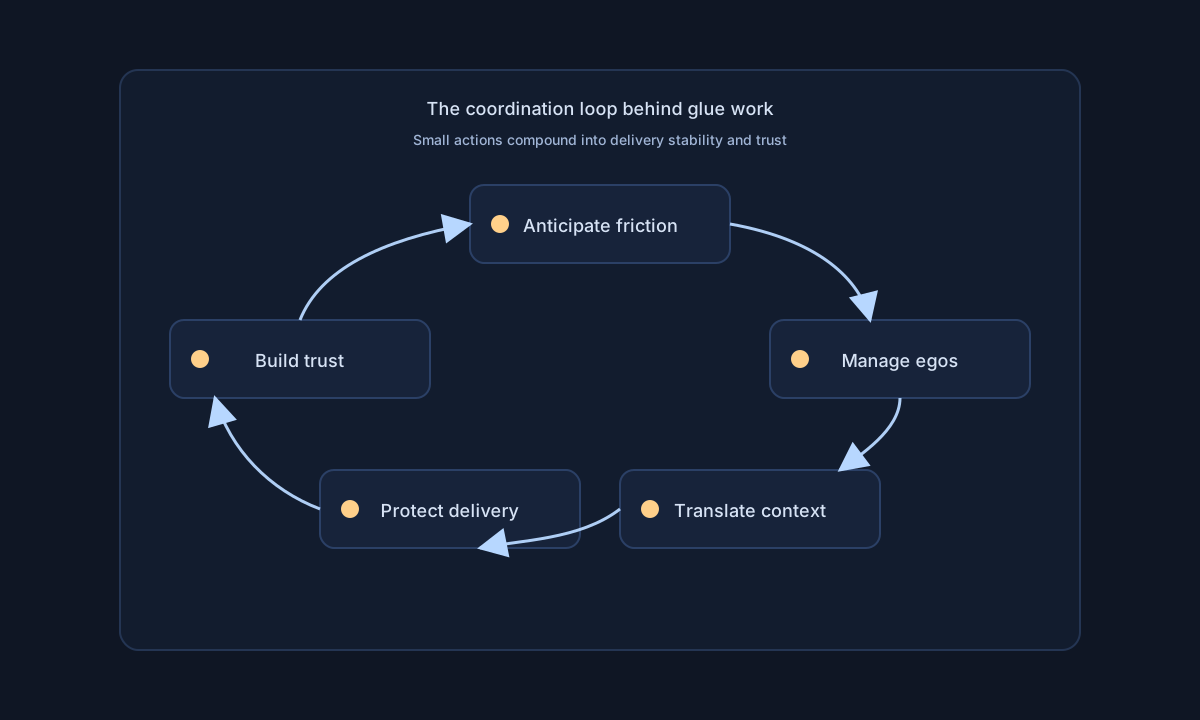
What makes the role difficult to replicate is that it relies on situational judgment rather than a checklist. A glue employee can see when a Slack thread is becoming a proxy battle, when an online meeting is missing the decision maker who will later veto the outcome, or when a fast moving initiative needs a pause to protect long term trust. Some years ago, a senior manager told me that the best on call shifts were not the quiet ones, but the ones where the team felt safe enough to surface uncertainty early. That kind of safety, explored in Google re:Work, is not an abstract HR slogan, it is an engineering control for coordination.
When evaluation systems miss the signal
Most performance systems are designed to count what is easy to count. They capture closed deals, merged pull requests, security events analyzed, tickets resolved, hours billed, and what fits neatly into spreadsheets. Yet glue work often produces outcomes that look like “nothing happened”, because the success is the absence of drama, the avoided incident, the meeting that never needed escalation. When organizations over index on output that is immediately attributable, they risk creating a culture where visible activity beats invisible stability.
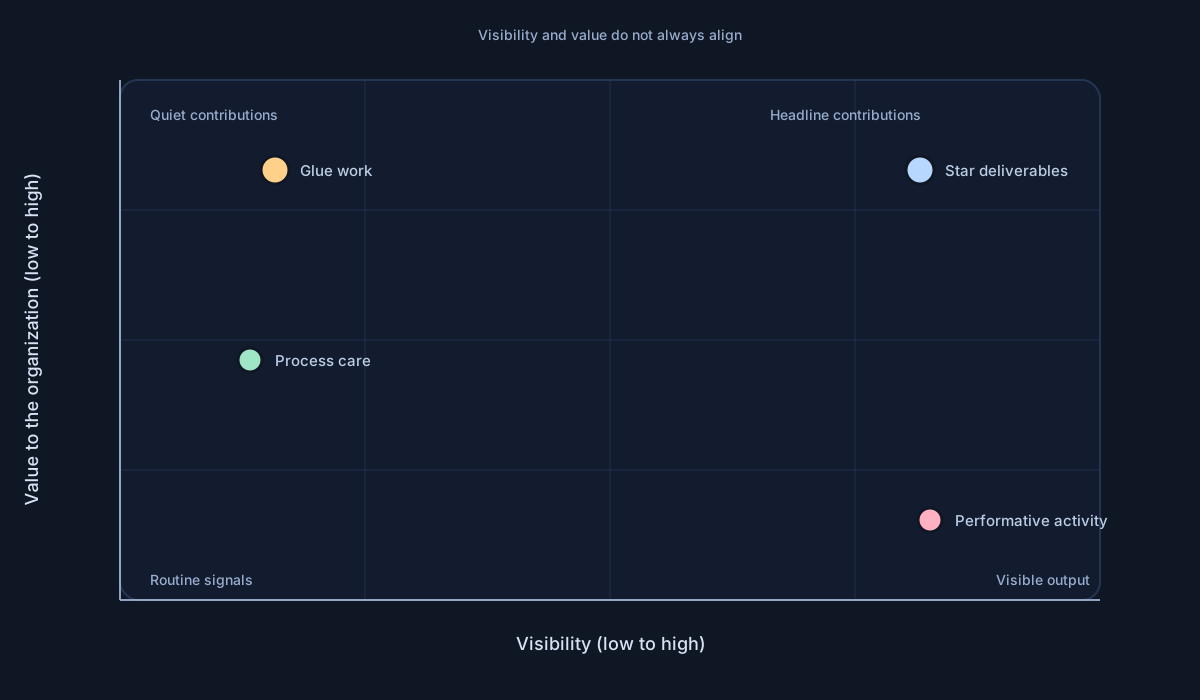
This is where the incentive structure quietly distorts behavior. If people learn that only individual heroics are rewarded, the rational strategy becomes self protection, not stewardship. Teams start optimizing for personal credit, not shared delivery, and the cost shows up later as fragile handoffs, rework, and distrust. The research on psychological safety is often discussed as culture, but it is also about performance under uncertainty, a point developed in Harvard Business School Working Knowledge through the lens of learning and error reporting. When glue employees are ignored, the organization does not just lose kindness, it loses an information system.
How leaders can protect the glue
Leaders do not need to romanticize glue work, they need to make it legible. That starts with recognizing the signals that typical scorecards miss, such as cross team trust, the health of handoffs, and the frequency with which problems are surfaced early rather than discovered late. IMO, a manager may change the tone of an entire department by moving from “who owned this mistake?” to “what did we learn, and who helped us see it sooner?”: the glue employees did not suddenly appear, they were already there, but the environment stopped penalizing them for investing in the collective.
Practical recognition also means protecting time and attention. If the glue person becomes the default dumping ground for every messy request, the organization converts a stabilizer into a bottleneck, then blames them for being overloaded. The healthier pattern is to treat glue work as capacity building, to rotate some coordination responsibilities so knowledge spreads, and to explicitly reward those who build reliable networks rather than just visible output. Many leadership and people operations frameworks emphasize retention and engagement because they shape delivery, and the guidance compiled by the Society for Human Resource Management is valuable precisely because it connects recognition, development, and role clarity to organizational resilience.
Glue employees are not a niche category. They are the connective tissue that allows talent to compound instead of collide. The most resilient teams I have seen, across different companies and high pressure environments, were not defined by constant brilliance. They were defined by a quieter asset: people who could hold the system together when deadlines, incidents, and competing egos threatened to pull it apart.