The Cloud Kill Switch: how Europe’s digital dependence became a Single Point of Failure
Imagine it’s Monday morning.
Hospitals can’t log into patient systems. Tax portals fail open with “service unavailable.” Municipalities can’t access email, document storage, or identity providers. Banks fall back to “degraded mode” and still can’t complete core transactions because APIs time out upstream.
No malware. No zero-day.
Just a policy change.
This is the uncomfortable thought experiment Europe should take seriously in 2026: what happens if a handful of non-European cloud and platform providers decide (or are forced) to deny service? In a tense geopolitical climate, “the cloud” is not just a technology choice; it’s part of the strategic surface area of a continent.
Two recent, seemingly unrelated episodes made this more concrete than any whitepaper:
- Microsoft disabled access to Azure for an Israeli intelligence unit (Unit 8200), showing how quickly a single vendor decision can remove critical capability.
- X (owned by Elon Musk) cut off the European Commission’s advertising account following a €120M fine, demonstrating that even communication channels used by institutions can be “revoked” overnight.
The point isn’t to debate the politics of these cases. The point is technical and systemic: modern digital services have control planes, and control planes have owners.
Technology isn’t neutral: control lives in the control plane
For years we treated digital globalization as if it were a neutral market: pick the best product, integrate, scale. But cloud services are not interchangeable commodities. They’re layered systems where a small number of actors control the “root switches”:
- Identity and access (IAM, SSO, conditional access)
- Billing and contract enforcement (what happens when the invoice isn’t the problem, but the policy is?)
- Control-plane APIs (the knobs that govern the data plane)
- Key management (who can deny access to keys, rotate them, or make them unusable?)
- Platform governance (terms of service, acceptable use, geopolitically-driven restrictions)
When those switches belong to external jurisdictions, the dependency becomes political by design.
This is what changes the conversation from “IT procurement” to strategic autonomy. Genuine technological sovereignty is slow, expensive, and unglamorous work: sustained R&D, industrial capacity, long-term political alignment, and investments whose payoff is measured in decades. Most importantly, it requires treating technology as a structural pillar of national security, comparable to defense and energy.
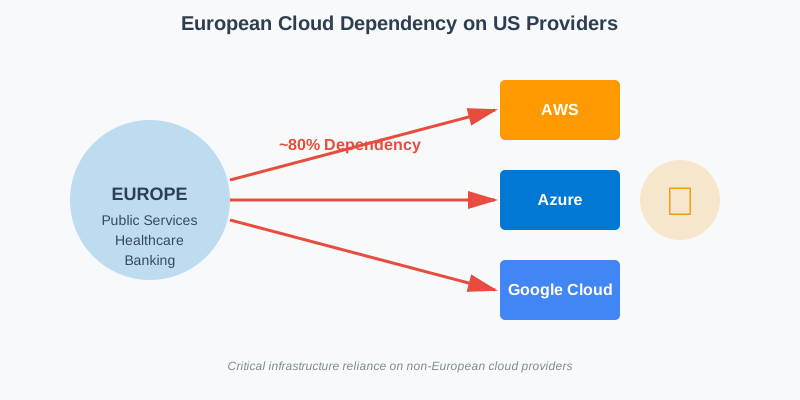
No country can credibly claim full sovereignty while depending on others for the core layers of the stack: cloud services, operating systems, semiconductors, and critical platform infrastructure.
This is why the debate around AI regulation is both necessary and incomplete. Regulations matter, but rules without leverage are fragile when the underlying platforms are built elsewhere, governed elsewhere, and optimized for priorities that may not match European interests.
Outages, supply chains, geopolitics: the same fragility pattern
In a hyperconnected world, incidents don’t stay local. They cascade because “independent” services frequently share the same upstream dependencies.
We’ve seen this repeatedly with major outages involving Amazon Web Services, Microsoft Azure, and Cloudflare. When AWS had its major outage in 2021, large parts of the internet became unreachable and business operations stalled across sectors. And the CrowdStrike incident that disrupted healthcare systems worldwide is a reminder that systemic fragility isn’t only about availability; it’s also about shared supply chains and monocultures.
These aren’t “just outages.” They are systemic risks that touch economic stability, public safety, and government continuity. Europe has digitized aggressively (healthcare, public administration, banking, education), but much of that digitalization runs on foundations:
- built outside Europe,
- controlled by foreign entities,
- and subject to external legal frameworks and policy constraints.
Availability is only one axis. The deeper vulnerability is governance: decisions made in Washington, Silicon Valley, or corporate boardrooms can reshape the digital landscape overnight. When platforms change policies, cloud providers adjust terms, or strategic priorities shift, Europe is often forced into a reactive posture.
In the long run, being reactive isn’t merely a competitive disadvantage; it’s a sovereignty problem.
What “European sovereignty” means in engineering terms
Technological sovereignty doesn’t mean rejecting cloud computing. It means having credible, local options and the ability to operate critical services independently.
Technically, that implies owning (or being able to independently reproduce) key layers:
- Hardware and manufacturing capacity (or at least trusted supply and strategic stock)
- Firmware and secure boot chain (the root of trust problem)
- Operating systems and update pipelines (who signs what, and who can revoke?)
- Virtualization / hypervisors (the isolation boundary for most workloads)
- Core cloud primitives (IAM, KMS, networking, observability, orchestration)
- Data services (databases, queues, object storage) with clear exit strategies
In plain terms: a European cloud built on European governance, with European operational control.
Yes, the timeline is daunting. Think decades, not quarters (often quoted as ~20 years for a full-stack outcome). Critics will call it too expensive or “impossible” against entrenched US and Asian giants.
But that objection misses the threat model. The tools of future conflicts (economic pressure, strategic denial, information warfare) operate in the digital domain. They can be deployed with a few policy changes, at machine speed.
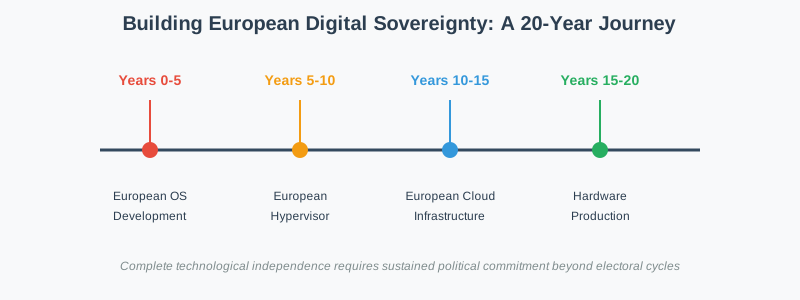
Building this capability requires components that work together. Control the base layer, and the upper layers become negotiable. Without it, every “sovereignty” initiative is built on someone else’s root.
Projects like Gaia-X are a step in the right direction, especially in terms of governance and interoperability goals, but the gap between framework and full-stack capability remains significant.
The hard part is governance (not only engineering)
The blocker isn’t mainly technical. It’s political and organizational.
Building long-term capability demands commitment over 20–30 years, far beyond typical legislative cycles, and requires coordination across countries with different priorities. It also requires treating digital infrastructure with the seriousness we reserve for defense: long planning horizons, resilient procurement, and sustained investment.
In today’s geopolitical chessboard, technology control translates into economic control and, increasingly, into security control.
China invested for decades in domestic ecosystems. The United States benefits from global hyperscalers and semiconductor leadership. Europe, despite deep technical talent and an enormous market, often ends up as a rule-maker without enforcement power: regulating platforms it doesn’t fundamentally control.
So the question is no longer whether Europe should pursue technological sovereignty, but whether it can build it before the window closes.
Every year of delay increases lock-in, raises migration costs, and deepens dependency. The Microsoft and X episodes aren’t just “news”; they are reminders that revocation is a feature of centralized platforms.
Technology is now too central to modern life, and too critical to competitiveness and national security, to be fully outsourced.
Europe’s choice is simple (even if execution is not): invest now in building real capability, or accept long-term dependence, along with the vulnerabilities and constraints that come with it.