Enterprise security faces new threat from AI-powered browsers
AI-powered browsers are here, and they’re fundamentally changing how people work, which naturally means they’re breaking all the security assumptions we’ve carefully built over the years.

Security firms and researchers are raising serious red flags about deploying these tools in corporate environments, and for good reason. Unlike the passive, read-only browsers we’ve relied on for decades, AI browsers are active agents that can think, remember, and act on their own. That combination (autonomous decision-making plus unrestricted access to sensitive data) creates security problems that most enterprises aren’t prepared for.
What makes AI browsers different, and dangerous
The problem is that AI browsers aren’t browsers in the traditional sense. They don’t just render pages and wait for user input. Instead, they actively process content, extract meaning, maintain memory across sessions, and execute complex tasks with minimal human supervision. Security researchers are increasingly concerned because this architectural shift breaks the basic assumptions underlying enterprise security. A traditional browser is mostly a viewing window; an AI browser is an autonomous agent that can make decisions, remember what it learned, and act on that knowledge across multiple systems.
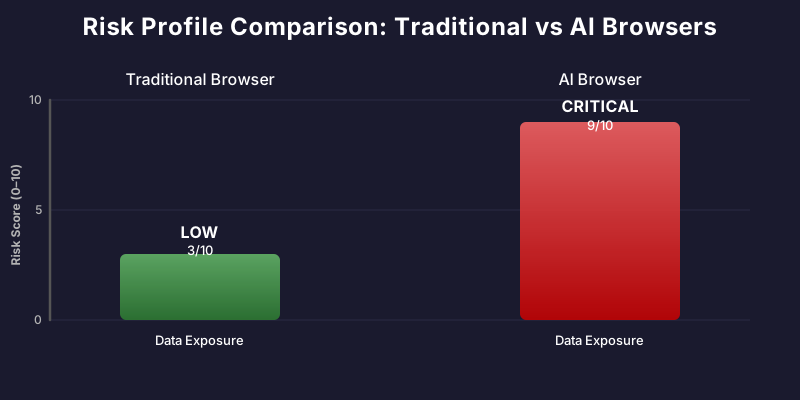
Here’s where it gets uncomfortable: these browsers often connect to cloud-based AI services to process what you’re doing in real-time. That means everything (your financial data, customer records, proprietary designs) potentially gets sent to external servers for analysis. And that’s just the data transmission problem. Beyond that, there’s the control problem. Check Point researcher Oded Vanunu puts it bluntly: enterprise IT teams have no way to effectively monitor or govern these tools. No centralized management console, no group policies, no audit trails that make sense. It’s like handing someone root access and hoping they don’t accidentally delete something important.
Prompt injection is the new SQL injection
The attack vector that keeps security professionals up at night is prompt injection. Imagine an attacker hiding malicious instructions in plain sight within a web page. The AI browser reads those instructions and treats them as legitimate commands, because to the AI, they’re just text that’s supposed to be acted upon. It’s similar to SQL injection, but at the linguistic level, and much harder to detect because there’s no obvious technical anomaly to flag.
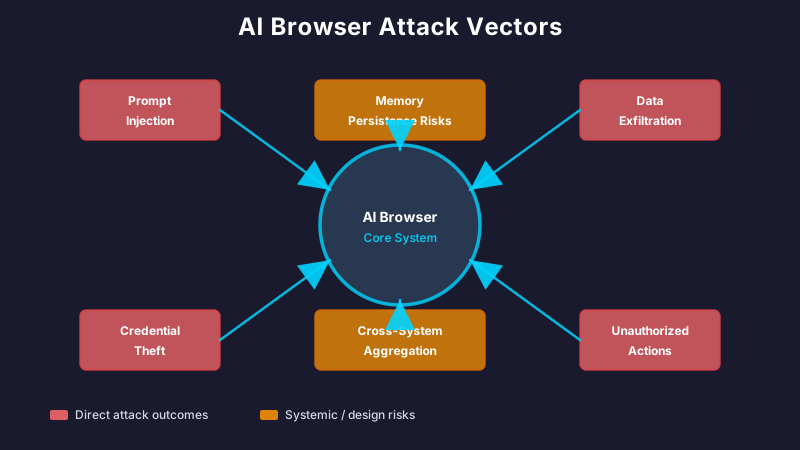
What makes this especially dangerous is the speed and scope. A single injected prompt can trigger a chain reaction of automated actions: extract sensitive data from a connected app, format it, package it, and send it somewhere external, all using the credentials the user has already provided to the browser. A human might pause and think “wait, that’s suspicious.” An AI doesn’t. It processes all instructions through the same lens and executes them with mechanical precision. Cybersecurity researchers have documented scenarios where this kind of attack could harvest credentials, exfiltrate data, or trigger unauthorized transactions before anyone realizes something went wrong.
The hidden data lake problem
Here’s something that’s rarely discussed: AI browsers don’t just process information, they collect and synthesize it. When a single browser session spans HR tools, CRM systems, financial platforms, and internal knowledge bases, the browser starts building a comprehensive profile of your organization’s operations. It’s like having an invisible analyst sitting in the background, connecting dots that were intentionally kept separate for compliance reasons.
This is a nightmare for regulated industries. HALOCK Security highlights how dangerous this becomes: if you work in healthcare, finance, or e-commerce, data compartmentalization isn’t optional, it’s a legal requirement. PCI-DSS, HIPAA, FINRA, and similar standards exist precisely because we learned the hard way that mixing datasets creates risk. But an AI browser with persistent memory will naturally do exactly that: it will remember that John in accounting has access to customer payment records, and it will synthesize that knowledge whether you wanted it to or not.
Then there’s the retention problem. Long after a user closes their browser tabs, these tools continue storing detailed records of what was viewed and accessed. If your data loss prevention team can’t audit what’s being retained (and most current DLP solutions can’t handle this), you’ve just created a hidden data repository that nobody knows about. The gap between what your security team can monitor and what’s actually happening is real, and it’s growing.
So what do we actually do about this?
The honest answer is: most organizations aren’t ready. Guidelines like UNI/PdR 174:2025 exist to help companies assess AI-related risks, but specific policies for governing AI browsers? Those are still being written. Security teams need to develop strategies that include three things: educating users about the risks, implementing technical controls to prevent deployment, and building monitoring that can actually detect when an AI browser is doing something it shouldn’t be.
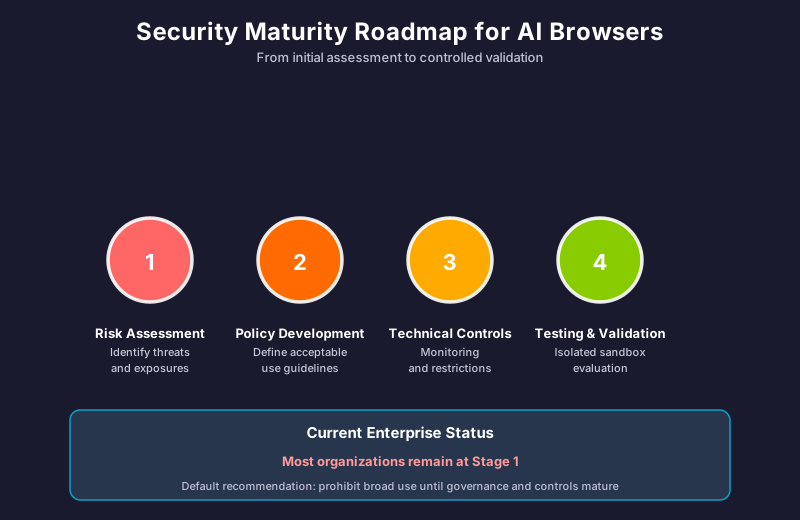
In practical terms, this means: lock down your endpoint controls to prevent unauthorized AI browser installations, create clear policies about when (if ever) these tools are acceptable, and invest in monitoring solutions that can understand AI-driven behavior. The teams that are being smart about this are testing these browsers in isolated environments first (sandboxes where they can watch what happens without risking production systems). They’re mapping data flows, understanding what gets sent where, and making informed decisions.
The reality is that there’s a massive gap between what AI browsers can do and what enterprise security infrastructure can handle. Most organizations should probably just say no for now. But if you do need to pilot these tools, do it with eyes wide open.
The uncomfortable truth about the future
We’re at a turning point. In a year or two, AI browsers won’t be experimental anymore, they’ll be mainstream, and a lot of people will want to use them because they’re genuinely useful. The productivity benefits are real. But so are the security risks.
The fundamental problem is that we’ve built enterprise security around the assumption that browsers are stupid. They’re pipelines. They take requests, fetch content, render it, done. We can monitor them, control them, log them. An AI browser breaks that mental model completely. It’s not a pipeline, it’s an intelligent actor with its own judgment, memory, and agency. That’s a different threat surface entirely, and we don’t have mature defenses yet.
Eventually, we’ll probably see enterprise versions of AI browsers with proper governance, audit trails, and policy controls. But that’s not today. Until those tools exist and mature, the smart play for most security-conscious organizations is to treat current AI browsers as shadow IT and push back against their use. The productivity gains aren’t worth the compliance and security headaches, at least not yet.