Beyond the Checklist: why true Security Leadership demands strategy, not just plans
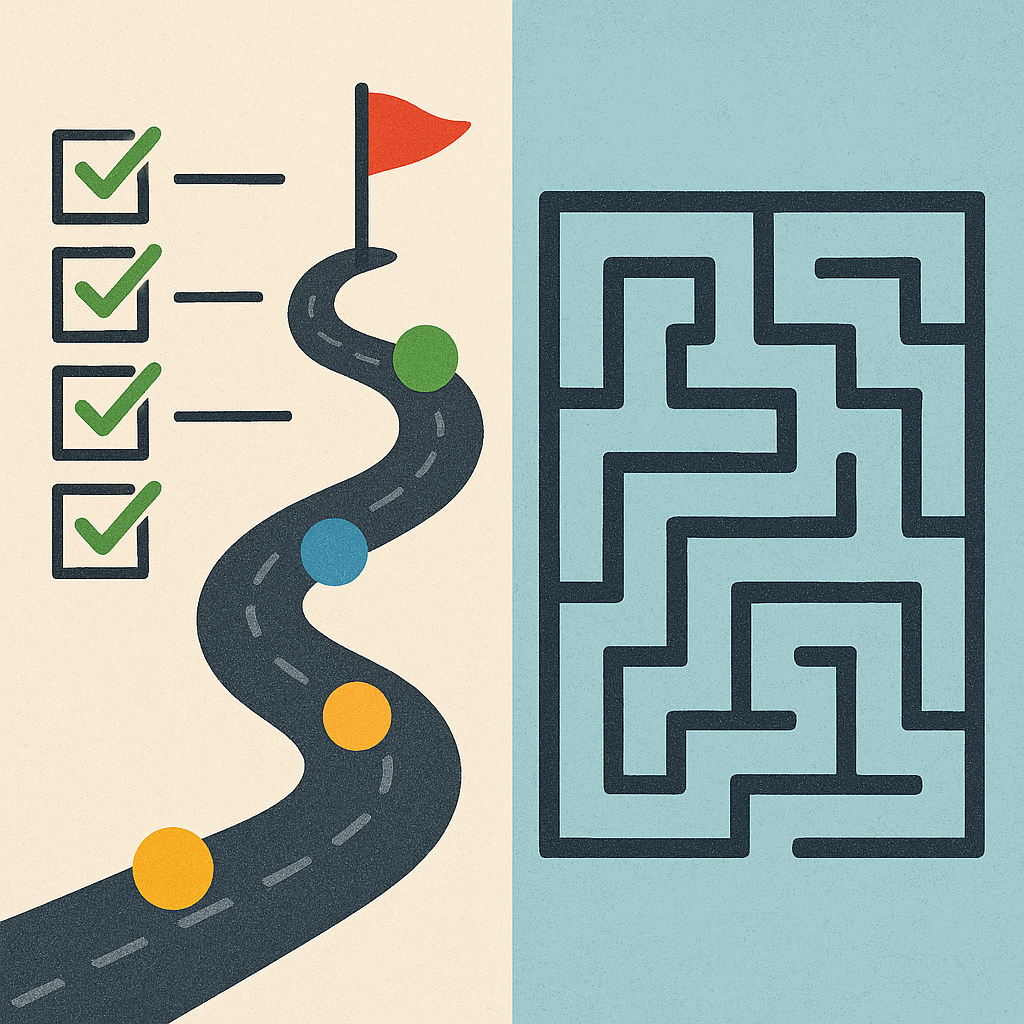
Here’s something I’ve noticed after years in cybersecurity leadership: we’re addicted to action. Give us a roadmap, a Gantt chart, or a deployment schedule showing everything in green, and we feel like we’re winning. But I’ve watched too many talented security leaders get blindsided by budget cuts or major incidents, only to realize they’d been confusing their to-do list with actual strategy.
Walk into most security teams today and you’ll find plenty of plans. Patch management schedules? Check. Tool rollout timelines? Absolutely. Compliance checklists? We’ve got stacks of them. What you won’t find as easily is genuine strategic thinking.
This article breaks down a critical problem in cybersecurity leadership using the “5P Strategic Lens” framework. It’s time we learned to tell the difference between a map and the actual territory we’re trying to navigate.
The core distinction: evolution vs. execution
The simplest way I can explain the difference between strategy and planning is this: one gives you direction, the other gives you motion.
Strategy tackles fundamental problems and positions your organization for what’s coming next. It answers the big questions: “Why are we doing this?” and “Where are we headed?” More importantly, it forces you to make tough choices about what you won’t do (which, in my experience, is often harder than deciding what you will do).
Planning handles the mechanics. It’s your “How,” “When,” and “Who.” Think of it as the operational roadmap that translates your strategy into tasks people can actually execute.
I can’t count how many times I’ve heard this in meetings: “Our strategy is to deploy an EDR solution and get ISO 27001 certified.”
Let me be blunt. That’s not a strategy. That’s a shopping list.
A real strategy sounds more like this: “We’re moving from perimeter-based defense to a Zero Trust architecture because we’ve gone remote-first. This means less dependence on VPNs and faster deployments for our developers.”
The plan is what comes next: rolling out the EDR, overhauling identity management, rewriting policies. Those are the steps that make your strategy real.
The 5p strategic lens for security leaders
The 5P framework breaks strategy into five components: Purpose, Positioning, Proposition, Power, and Profit Model. While it was designed for general business strategy, it translates surprisingly well to cybersecurity if you know how to adapt it.
1. Purpose: Why do we exist?
Most security teams I’ve worked with define their purpose defensively: “To protect the company from cyber threats.” Technically correct, sure. But it’s also completely uninspiring and offers zero differentiation.
A strategic purpose connects directly to the business mission. Working for a fintech? Your purpose shouldn’t be just “security.” It should be something like “Enabling the fastest, most trusted digital transactions in the market.”
- Strategic Question: If your security team vanished tomorrow, what business value would disappear with it (beyond just the obvious “we’d be less safe”)?
2. Positioning: Where will we compete?
In traditional business, positioning is about choosing your target market. In cybersecurity, it’s about defining your risk appetite and trust model. Are you the “Fort Knox” of your industry, where security is a premium feature you sell? Or are you the “lean and agile” player that accepts calculated risks to move faster?
- Strategic Question: Do we want security to be a visible differentiator to customers, or an invisible hygiene factor?
3. Proposition: What makes us unique?
This is your value proposition to the rest of the organization. Think about it: why should the DevOps team actually want to work with you instead of routing around you? A weak proposition sounds like: “We enforce the rules.” A strategic proposition sounds like: “We provide guardrails that let engineering ship code 30% faster without breaking compliance.”
- Strategic Question: What operational friction are we removing for the business?
4. Power: Core capabilities
This is about your unfair advantages. In cybersecurity, power doesn’t come from buying the same tools everyone else has. It comes from your unique mix of talent, proprietary threat intelligence, or specialized visibility (like deep knowledge of your OT environment).
- Strategic Question: What can our team do better than any managed service provider could do for us?
5. Profit model: Sustainability
Since security is typically a cost center, “Profit Model” really means “ROI and long-term sustainability.” The question is simple: how do we keep growing without breaking the bank? Are you scaling headcount linearly with every new application (spoiler: that doesn’t work), or are you investing in automation and “security as code” to scale smarter?
- Strategic Question: Does our cost of security decrease per unit of business output over time?
The roadmap of execution: where strategy dies
Once you’ve nailed down your strategy (thinking 3 to 5 years out), then you build your plan. A good plan includes the basics: milestones, tasks, owners, resources, and dependencies.
But here’s where most leaders get stuck. The execution roadmap is seductive. It feels productive. Checking off tasks gives you that little dopamine hit. Debating the existential purpose of your security program? Not so much.
The “silo” mistake
The most common failure mode I see is what I call “planning in a vacuum.” This happens when a security team buys some shiny new tool (maybe a cutting-edge AI anomaly detector) because it was in the budget and “on the plan,” even though it doesn’t address their actual strategic problem. Maybe they really needed better asset visibility or basic identity hygiene, not another detection tool.
The plan succeeded (you bought the tool). The strategy failed (you didn’t reduce risk).
Time horizons: the pulse of leadership
One thing that often gets lost in these conversations is the difference in time horizons.
- Strategy plays the long game (3 to 5 years). It shouldn’t shift every time a vendor announces a new feature or CNN runs a scary headline about the latest breach. Strategy changes only when the fundamentals shift: think generative AI entering the scene, a global pandemic forcing remote work, or a major merger.
- Plans operate in weeks and months. They should change. Actually, they must change. Deployment failed? Adjust the plan. Lost a key team member? Adjust the plan. But you don’t change your destination (strategy) just because you hit some potholes along the way (plan).
Conclusion: anchor in purpose
Look, I get it. The threat landscape keeps getting more complex. NIS2 compliance is looming. AI is reshaping everything we thought we knew about attacks and defense. When things get overwhelming, it’s tempting to retreat into the comfort zone of micromanagement and obsess over your task list.
But here’s the thing: as leaders, our job is to keep our heads up above the Gantt charts. We need to make sure that the ladder we’re climbing so efficiently is actually leaning against the right wall.
In a world of asymmetric threats and limited budgets, a plan without strategy is just a well-organized way to fail.
Key takeaways for the CISO
- Don’t confuse motion with progress. A busy roadmap means nothing if you’re headed in the wrong direction.
- Apply the 5P Lens. Work out your Purpose, Positioning, Proposition, Power, and Sustainability before you even think about opening Microsoft Project.
- Different timescales need different review cycles. Check your tasks weekly, your plans monthly, but your strategy only quarterly or annually.
- Alignment isn’t optional. Your security strategy needs to grow from your business strategy, not exist separately from it.