Things I learned from bad managers
One of the things I find myself saying most often to the people on my team is this: learn from everyone, not just the best. The best will show you what to aim for. The worst will show you the full catalog of things to avoid, and that catalog, in my experience, tends to be considerably longer and more instructive.

I have had dozens of managers over the course of my working life. Some were excellent. A few were genuinely formative in the positive sense, the kind of people whose judgment you still find yourself invoking years after you have stopped working with them. But if I am honest about where I learned the most, it was not from the best ones. It was from the ones who got it wrong, sometimes spectacularly, sometimes in that slow, grinding way that is harder to name but just as damaging. Each of them handed me, without meaning to, a precise and detailed lesson in how not to manage people. I have tried to be a diligent student.
What follows is not a theoretical framework. It is a field report.
The brilliant technician who forgot there were humans in the room
The first archetype I encountered, and the one I suspect is most familiar to anyone who has worked in tech, is the manager who is technically formidable and interpersonally catastrophic. I have had at least two of these. The kind of person who can hold an entire system architecture in their head, who spots the flaw in your reasoning before you have finished the sentence, who writes code that is genuinely elegant and knows exactly why it is.
And who has, to borrow a phrase I have used to colleagues more than once, the emotional intelligence of a slate slab.
These managers are not malicious. That is almost the point. Malice would at least imply awareness of the other person. What they have instead is a profound, seemingly structural inability to register that the people around them have an interior life that matters to the work. Feedback delivered without any regard for how it lands. Decisions made and communicated as facts rather than as things worth discussing. Frustration expressed with a directness that reads, to the recipient, less like candor and more like contempt.
What I learned from these managers is that technical excellence and leadership are not on the same spectrum. They are different skills, and the assumption that one implies the other is one of the most costly mistakes an organization can make. Promoting your best engineer into a management role because they are your best engineer is a bit like asking your best surgeon to run the hospital. The skills overlap less than you would think, and the damage from the mismatch is borne almost entirely by the people being managed.
I also learned something subtler: that a technically brilliant manager who cannot connect with people will, over time, select for a team of people who communicate like they do. The people who need a different kind of engagement will leave, and what remains is a team that functions smoothly only by the narrow metric of outputs, while quietly hemorrhaging everything that cannot be measured.
The technically lost leader who somehow made everyone better
On the opposite end of the spectrum, I have worked under people who could not have told you the difference between a load balancer and a sandwich, and who built some of the most productive and cohesive teams I have ever been part of.
These managers had something the technical wizards lacked: a genuine, almost instinctive ability to understand what people needed in order to do their best work. They knew when to step in and when to get out of the way. They delegated not as a last resort but as a first principle, with the implicit message that they trusted you to handle it, which turned out to be one of the most motivating things a manager can communicate. They could read a room. They could tell when someone was struggling before that person had said a word. And they had a talent for framing work in a way that made people feel like they were building something worth building, rather than closing tickets.
The lesson here is uncomfortable for anyone who has spent years developing deep technical expertise: people management is a skill. Not a soft skill, a phrase I find mildly insulting in its implication that softness equals simplicity, but a genuine, learnable, practicable skill that requires as much deliberate effort to develop as any technical discipline. The fact that it does not come with a certification or a Stack Overflow answer does not make it less real.
These managers also taught me something about ego. Managing technical people without being technical yourself requires a certain security, a willingness to sit in a room full of people who know more than you about the thing the room is ostensibly about, and still contribute something valuable. The ones who did it well had made peace with that asymmetry. They were not threatened by expertise they did not have. They were, if anything, attracted to it.
The disillusioned veteran waiting for the clock to run out
Then there is the archetype that is perhaps the saddest to witness: the manager who has simply stopped believing they matter.
I worked under one of these for long enough to understand the mechanism. He was not incompetent. He had been, at some earlier point in his career, genuinely engaged. But by the time I encountered him, he was a few years from retirement and had arrived at a conclusion that seemed, to him, like hard-won wisdom: nothing he did would change much, the organization would do what it was going to do regardless, and the path of least resistance was to let the team manage itself while he managed his own exit with minimal friction.
The result was a form of delegation that looked, on paper, like trust, but was actually abandonment. Questions went unanswered not because he was busy but because he had decided that answering them was not worth the energy. Decisions that needed escalation sat in a queue that never moved. Conflicts that needed mediation were met with a shrug that communicated, clearly enough, that this was now your problem.
What this taught me is that disengagement is contagious, and it is particularly virulent when it comes from above. A team that watches its manager stop caring will, with impressive speed, recalibrate its own level of investment accordingly. Not out of spite, but out of a rational adjustment to the environment. Why would you care more about the work than the person nominally responsible for it?
It also taught me something about the story we tell ourselves to justify coasting. The disillusioned veteran genuinely believed he was doing the team a favor by staying out of their way. He had reframed his disengagement as respect for their autonomy. And there is, to be fair, a kernel of something real in that framing. But a kernel is not a policy, and the difference between trusting your team and abandoning your team is not always visible from the inside.
The visionary who lived permanently in the future
There is one more archetype that deserves its own entry, partly because it is so common in the tech industry, and partly because it is the hardest to criticize without sounding like someone who simply lacks imagination: the visionary manager.
You will recognize them immediately. They arrive at meetings with the energy of someone who has just had a revelation in the shower, which is, in fact, where most of their strategic planning takes place. They speak exclusively in metaphors. The company is not building software, it is “redefining the relationship between humans and information.” The team is not fixing bugs, it is “laying the foundations of a new digital infrastructure.” A minor UX improvement becomes, in their hands, “a paradigm shift in how users experience agency.”
They have read every important business book published since 1995 and can quote from all of them at a moment’s notice, usually in the middle of a sprint review. They are genuinely excited about the future, which would be admirable if the future they are excited about did not keep moving eighteen months ahead of wherever the team currently is. By the time the team has shipped the thing the visionary was excited about last quarter, the visionary has already mentally shipped three subsequent versions and is now primarily interested in discussing what comes after those.
The practical consequence of working under a visionary is a particular kind of organizational vertigo. The direction changes often enough that you develop a professional skill you did not know you needed: the ability to nod with conviction while internally suspending all judgment about whether this new direction will still exist in six weeks. It usually will not. Not because the visionary is wrong, exactly, but because the visionary is always slightly more interested in the next idea than in the current one, and the current one requires the tedious work of actually being executed.
I once worked under someone of this type who, over the course of a single quarter, reoriented the team’s priorities four times. Each reorientation came with a new slide deck, a new set of metaphors, and a palpable enthusiasm that made it genuinely difficult to raise the obvious objection, which was that we were still in the middle of the previous reorientation. Raising this objection, when someone finally did, produced a response that I have thought about many times since: “We need to be comfortable with ambiguity.” Which is, in the vocabulary of the visionary, a sentence that means many things, none of which is an answer to the question that was actually asked.
What the visionary manager teaches you, eventually, is the difference between vision and strategy. Vision is the easy part. Vision is free, it costs nothing, it requires no follow-through and generates no accountability. Strategy is what happens when you take a vision and ask the uncomfortable question of how, specifically, you are going to get there, and who is going to do which part, and what you will do when the first three approaches do not work. The visionary is almost always excellent at the first part and allergic to the second.
They also teach you something about the seductive quality of enthusiasm. It is very difficult to be in a room with someone who is genuinely, infectiously excited about an idea and maintain the critical distance necessary to evaluate whether the idea is actually good. Enthusiasm is a form of social pressure, and visionary managers, consciously or not, tend to use it as one. The team member who raises a practical objection in the middle of a visionary’s pitch will often find themselves cast, at least momentarily, as the person who does not get it. And nobody wants to be the person who does not get it.
The cure, I eventually discovered, is simple but requires practice: ask for the next three steps. Not the destination, not the metaphor, not the paradigm shift. Just the next three concrete steps. The answer to that question will tell you, with remarkable efficiency, whether you are dealing with a vision or a plan. And whether you should update your calendar or your CV.
The anxious Atlas who could not put the world down
The last archetype is the one I have found most difficult to navigate, because it comes wrapped in qualities that look, initially, like virtues.
The anxious manager is not lazy. Not distant. Not disengaged. They are, if anything, too engaged, in the way that a person who grabs your arm to stop you from tripping sometimes causes the fall themselves. They are present at every stage of every task. They follow up on things that were not due for another week. They send messages at eleven at night not because there is a crisis but because the absence of a status update has generated, in their mind, a probability distribution of possible crises that must be addressed immediately.
I had one of these, and I spent a not insignificant portion of my working hours during that period managing their anxiety rather than doing the work I had been hired to do. Every deliverable had to be narrated as it was being produced. Every decision, no matter how minor, had to pass through a review process that existed primarily to give the manager the feeling of control rather than any actual improvement in outcome. The micromanagement was not punitive, it was anxious, which made it harder to push back against without feeling like you were kicking someone who was already down.
What I learned from this manager is that the need for control, when it is driven by fear rather than by a genuine assessment of risk, is one of the most exhausting things a team can be subjected to. It signals, at a very basic level, a failure of trust. And teams that are not trusted, that are watched and checked and followed up on at every step, will eventually stop making decisions without permission, which means they will stop thinking like owners and start thinking like contractors. The manager who tries to carry everything will succeed, in the end, only in making sure that no one else learns to carry anything.
There is a particular irony in the anxious manager archetype: the more tightly they hold the reins, the more fragile the team becomes, and the more the manager’s original anxiety is, in a roundabout way, justified. It is a self-fulfilling loop, and the only way out of it requires a kind of deliberate, uncomfortable letting go that does not come naturally to people for whom control is how they manage fear.
The common thread across all of these people, the technically brilliant but humanly absent, the technically lost but people-smart, the checked-out veteran, the anxious micromanager, is that each of them had found a way of managing that worked for them, in the narrow sense that it helped them cope with their own relationship to the role. What none of them had fully reckoned with was the cost that their coping style imposed on everyone else.
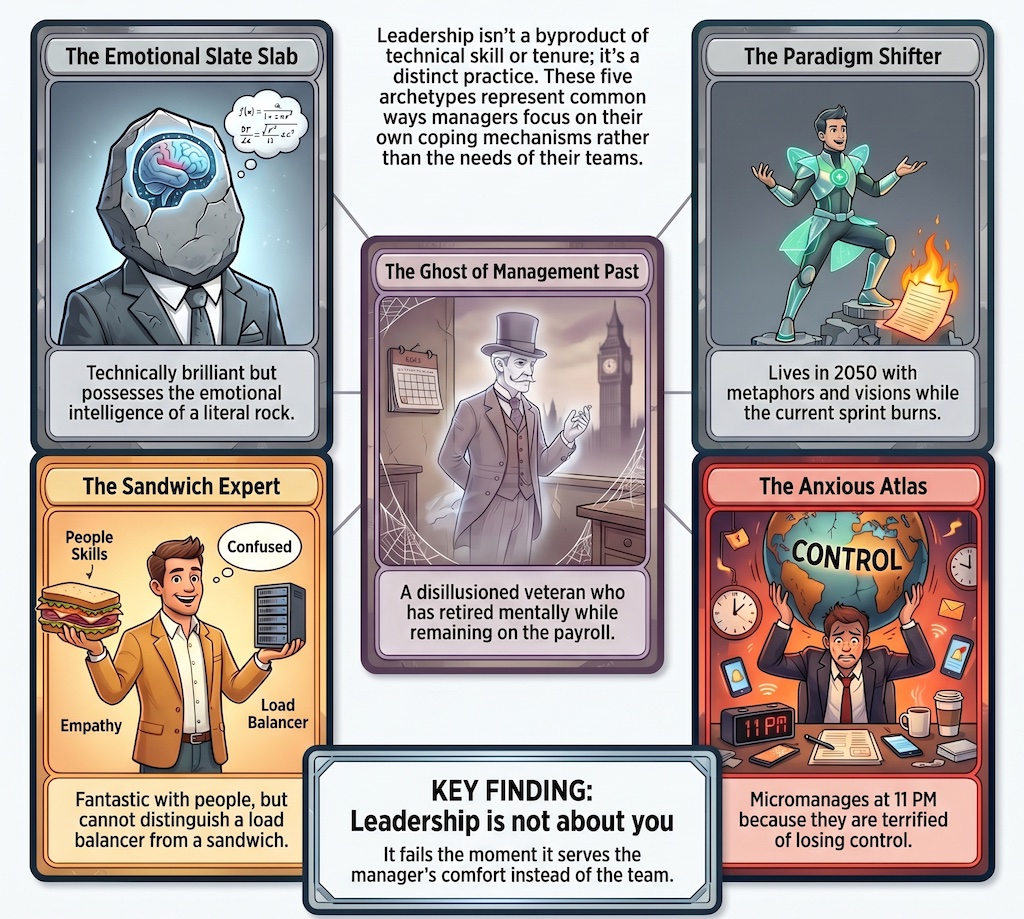
That is, perhaps, the most useful lesson any bad manager can teach you: leadership is not primarily about you. The moment it becomes primarily about you, whether about your comfort, your anxiety, your status, or your checked-out serenity, it stops being leadership and becomes something else entirely. Something that the people in the room learn from, certainly. Just not in the way you intended.