What the seven layers of cybersecurity maturity actually require, from alert fatigue to autonomous defense
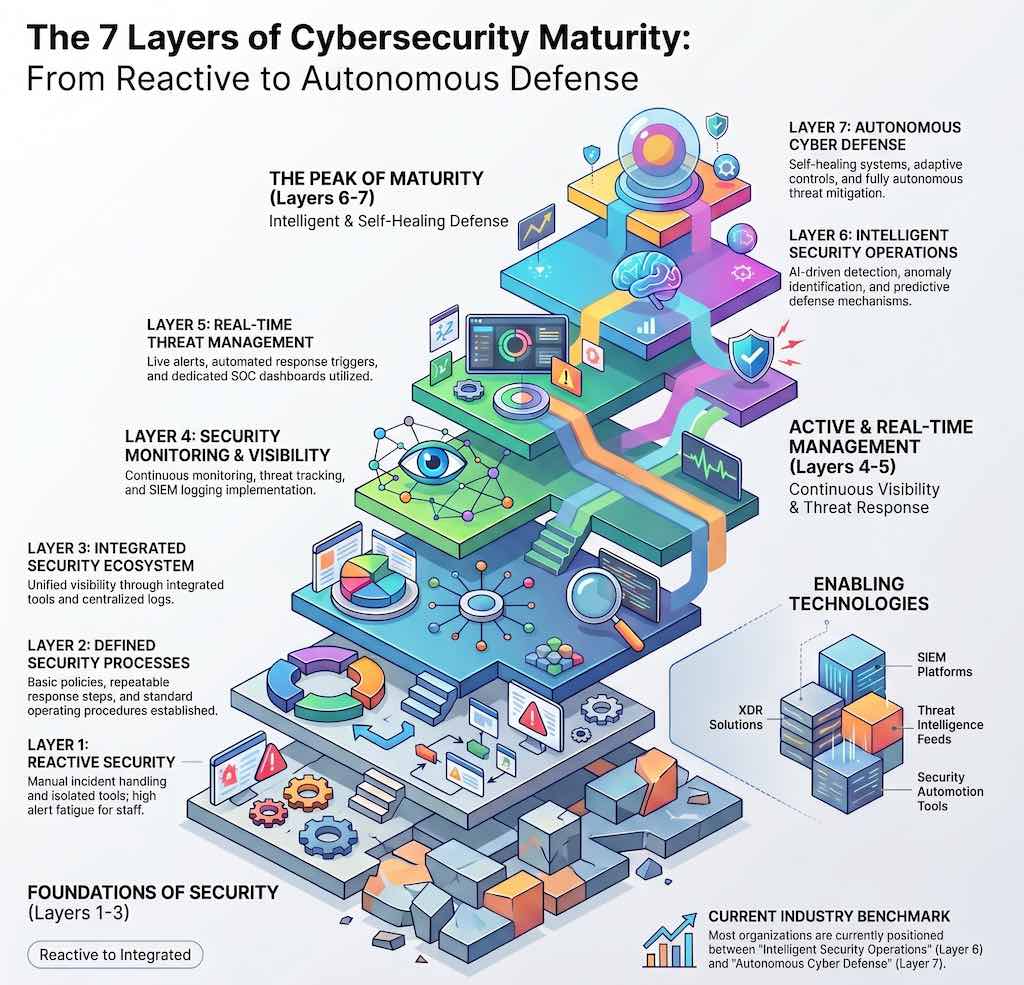
Layer 6 is more aspirational than descriptive for most organizations. The reality for a significant portion of security teams is closer to Layer 1: manual incident handling, alert fatigue, and a collection of point tools that do not talk to each other. The maturity model is useful precisely because it names the gap.
In brief
- Most security teams operate reactively, drowning in alerts from isolated tools with no unified picture of the threat landscape.
- Maturity is a progression through seven distinct layers, each requiring specific capabilities before the next becomes meaningful.
- Integration and centralized visibility (Layers 3 and 4) are the unglamorous foundation that everything else depends on.
- Intelligent Security Operations (Layer 6) is where current best-in-class organizations operate, using SIEM, XDR, and threat intelligence feeds together.
- Autonomous Cyber Defense (Layer 7) is achievable in narrow domains today, but it requires humans in the loop where the blast radius of a wrong decision is high.
- The goal is a security function that detects earlier, responds faster, and continuously reduces business impact — not more security theater.
The reactive trap of Layers 1 and 2, and why processes matter
Reactive Security is what happens when an organization acquires security tools faster than it acquires operational discipline, not a strategic choice anyone makes deliberately. Alerts fire. Someone investigates when they have time. There is no defined playbook for what “investigated” means, no threshold for escalation, and no institutional memory of what happened last quarter. The tools are isolated because nobody budgeted for integration. The analysts are exhausted because triaging noise is not interesting work, and the interesting incidents are indistinguishable from the noise.
The step from Layer 1 to Layer 2 is deceptively simple on paper: write down what you do. Defined Security Processes means basic policies, repeatable response steps, and standard procedures. In practice, it requires someone to spend weeks documenting workflows that nobody has ever articulated, convincing teams to follow them, and then maintaining them as the environment changes. It is the least glamorous work in security operations, which is probably why so many organizations skip it and go straight to buying another tool instead. As I wrote in The great SOC charade, a SOC without process is just a room full of dashboards nobody fully understands.
Integration first, the unsexy prerequisite at Layers 3 and 4
An Integrated Security Ecosystem (Layer 3) means that your tools share context. Logs from the firewall, the endpoint, the identity provider, and the cloud workloads all flow into a place where a human or a detection rule can reason about them together. Centralized logs. Unified visibility. This sounds like infrastructure work, because it is. It is also where most security programs stall. Every tool vendor promises easy integration. Few deliver it without significant engineering investment, custom connectors, and ongoing maintenance. Until this layer is solid, Security Monitoring and Visibility (Layer 4) is aspirational: you cannot do continuous monitoring and meaningful threat tracking if your telemetry has gaps the size of an entire network segment.
The two layers are tightly coupled. You cannot do Layer 4 well without having done Layer 3 properly. SIEM logging without data quality is noise amplification, not detection. Organizations that rush to stand up a SIEM before fixing their log collection end up with impressive-looking dashboards that alert on everything and mean nothing. I have seen this pattern often enough that I now consider it a reliable indicator of a security program that prioritizes appearances over outcomes, a topic I covered more directly in How to build a Security Operations Center on a budget.
Real-time threat management at Layer 5 turns the SOC into an operational center
Real-Time Threat Management is where a security function starts to look like an operational discipline rather than an IT support function. Live alerts with meaningful context, automated response triggers for well-understood scenarios, SOC dashboards that surface the right information at the right time. The word “real-time” does significant work here. It means that when something significant happens, the detection-to-response cycle is measured in minutes rather than days, not that every alert triggers immediate automated action.
The SOC at this layer needs people with the right allocation strategy. A poorly structured team will burn through its L1 analysts on false positives while serious incidents age in the queue. I discussed the practical staffing approaches in Staffing strategies for an effective SOC: the 60/30/10 distribution across tiers, the importance of dynamic alert quotas, the follow-the-sun models for global coverage. None of that works without the telemetry quality established at Layers 3 and 4. The layers are foundations you build on, not stages you pass through and leave behind — cracks at the bottom propagate upward.
Intelligent security operations at Layer 6, where most teams are today
Intelligent Security Operations is the current frontier for well-resourced security teams. AI-driven detection, anomaly identification, predictive defense. This requires SIEM platforms, XDR solutions, threat intelligence feeds, and security automation tools used together. They allow detection of behavioral anomalies that rule-based systems miss, correlation of indicators across kill chain stages, and automated containment of well-understood threat patterns.
The honest caveat is that “AI-driven detection” covers a wide spectrum. At the high end, it means models trained on your specific environment’s telemetry, tuned continuously as the environment and threat landscape evolve. At the low end, it means a vendor has bolted a machine learning label onto a slightly improved signature engine. The difference matters operationally. The risk of over-trusting automated detection systems is well-documented: as I wrote in When automation hits the fan, a misconfigured automation pipeline that processes unvalidated threat intelligence can, under the right conditions, take down two thousand endpoints before anyone realizes something is wrong. Intelligent operations require intelligent oversight, not the removal of it.
The Cloud Security Alliance’s AI Maturity Model for Cybersecurity describes a parallel hierarchy worth cross-referencing here: their Level 3 (AI Collaboration) aligns closely with what Layer 6 demands, where specialized AI systems are trusted with specific decisions but humans retain accountability for the outcomes. That is a reasonable operational posture for most organizations operating in this layer.
Autonomous defense at Layer 7, and the role humans still play
Autonomous Cyber Defense is the most advanced layer. Self-healing systems, adaptive controls, autonomous threat mitigation. Narrow implementations already exist: automated quarantine of compromised endpoints, dynamic firewall rule updates in response to active exploitation, self-remediating misconfigurations in cloud environments. This is not a distant sci-fi scenario. What does not yet exist reliably is a general-purpose autonomous defense system that can handle novel threats, make correct attribution decisions, and escalate appropriately without human supervision.
The framing that autonomous defense means removing humans is a persistent and dangerous misreading. What it actually requires is a clear model of which decisions are safe to automate and which are not. Blocking a known-malicious hash on an endpoint is safe to automate. Isolating a critical production server because an anomaly detection model flagged unusual traffic at 2 AM requires a human in the loop, because the cost of being wrong is potentially higher than the cost of the threat. The agentic AI discussion in enterprise contexts points in the same direction: autonomous actors operating within a security infrastructure need boundaries, audit trails, and override mechanisms built in from the start, not bolted on after the first incident.
The goal at every layer is the same: a security function that detects earlier, responds faster, learns continuously, and reduces business impact. Moving from Layer 1 to Layer 7 is an organizational transformation, not a product purchase, and there are seven layers for a reason. You cannot skip the middle ones.
FAQ
What are the seven layers of cybersecurity maturity?
The seven layers progress from Reactive Security (manual incident handling) through Defined Processes, Integrated Ecosystem, Security Monitoring and Visibility, Real-Time Threat Management, and Intelligent Security Operations, up to Autonomous Cyber Defense with self-healing systems and adaptive controls.
Does autonomous cyber defense mean removing human analysts?
No. Autonomous defense means stronger signals, safer automation, and better prioritization so that human oversight is applied where risk is genuinely high, not wasted on noise that machines can handle reliably.
What tools are typically used at Layer 6, Intelligent Security Operations?
Layer 6 commonly relies on SIEM platforms, XDR solutions, threat intelligence feeds, and security automation tools to enable AI-driven detection, anomaly identification, and predictive defense.