The day ctrl-alt-delete stopped killing things and started letting them in
There is a particular shade of teal that anyone who touched a Windows NT domain in the late 1990s will recognize on sight, the color of the login background, sitting behind a small gray dialog box that said, in a font already looking dated the day it shipped, Press Ctrl+Alt+Delete to log on. I stared at that screen for the first time in a small office outside Rome, in my first real job as a programmer, on a machine that was probably older than some of my code reviews today. I remember thinking it was a strange sentence. Everyone I knew who had touched a PC before that point had learned Ctrl+Alt+Del as the universal panic button, the thing you mashed when a program froze and you needed the machine to forget everything and start over. And now this same combination, this same digital “I give up,” was the front door.
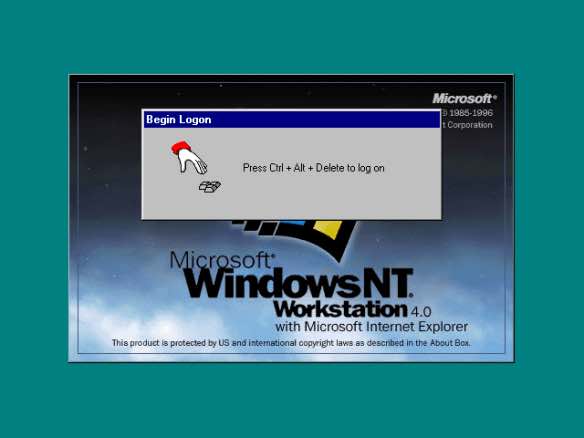
Windows NT 4.0 turns thirty on August 24, 2026. It shipped to retail on that date in 1996, a year after Windows 95 had already reset public expectations of what a desktop should look like, and a year before most small Italian businesses I knew had even heard the word “domain” used outside of a real estate context. My employer had, somehow, gotten ahead of the curve. We ran an NT4 domain with a handful of workstations, one server humming in a converted storage closet, and a system administrator (also our accountant, also occasionally the person who fixed the coffee machine) who treated the whole setup with the mixture of pride and terror that anyone running production infrastructure on a shoestring budget will recognize.
In brief
- Windows NT 4.0 shipped to retail on August 24, 1996, bringing the Windows 95 interface to Microsoft’s server-grade, protected-memory kernel for the first time.
- The Ctrl+Alt+Delete login prompt was not an aesthetic choice. It implements what Microsoft calls a Secure Attention Sequence, a keyboard signal that only the operating system kernel can intercept.
- The same three keys that had meant “reboot this thing” since the original IBM PC became, on NT, the only trustworthy way to start a login session.
- Bill Gates publicly called the design “a mistake” in 2013, though his complaint was about user convenience, not about the underlying security logic, which was sound.
- Thirty years later, the core idea behind the SAS (an unspoofable channel for a security-critical action) is still exactly what modern identity and zero-trust architectures are chasing, just with better cryptography and worse marketing copy.
A blue screen that was not the bad kind
Before NT4 arrived in that office, our daily computing experience was built on Windows 95 and, for anyone touching the file server, whatever flavor of Novell or peer-to-peer sharing we could bolt together with duct tape and optimism. Ctrl+Alt+Del on those machines was a purely destructive gesture. It killed a hung task, or if you were unlucky, it took the whole session with it. Nobody thought of it as an entry point. It was an exit, and often an ugly one.
Then the NT4 boxes showed up, with their Windows 95 shell wrapped around an entirely different animal underneath: a hybrid kernel, proper protected memory, and a security subsystem that actually meant something. The Wikipedia entry on NT 4.0 lists the features dryly: a Crypto API, DCOM, TAPI 2.0, a new Task Manager, GDI moved into kernel mode for performance. What the changelog does not capture is the feeling of sitting down at one of those machines for the first time as a junior programmer who, until then, had mostly experienced computers as personal, single-user, blissfully unaccountable devices. NT4 introduced the very concept of “this machine belongs to an organization, and the organization gets to know who you are before you touch anything.” For a twenty-something who had learned to code on machines that trusted you completely, it was a small but real paradigm shift, delivered through an unglamorous gray dialog box.
I did not understand, at the time, why the machine insisted on that specific gesture before letting me in. It felt almost punitive, like the system was making me prove I really wanted access by asking me to perform the universal gesture of giving up first. It took years, and a career detour into digital forensics and incident response, before I appreciated that this apparent contradiction was actually the entire point.
The three keys nobody could steal
The technical name for what NT4 was doing is the Secure Attention Sequence, or SAS. According to the history compiled by Bytellect, during early Windows NT development around 1989, Microsoft’s security architects needed a keyboard combination they could guarantee no application, malicious or otherwise, would ever be listening for. Every other plausible combination was already claimed by some shipping piece of software. Ctrl+Alt+Delete was free, precisely because its established job was to reboot the machine, an act so destructive that no well-behaved application had any reason to intercept it.
That accidental availability turned out to be a security gift. As Larry Osterman, the Microsoft engineer who documented the decision, explains, the combination is handled at a level of the keyboard driver stack that user-mode software cannot touch. On Windows NT and its descendants, once the SAS protection is active, that keystroke always, unconditionally, switches to a secure desktop and invokes the real Windows logon interface. No rogue program running in your session can throw up a convincing fake login box and quietly harvest your password, because it cannot fake the response to a signal it never receives in the first place. This is the specific attack the mechanism was built to close: login spoofing, in which malware displays a counterfeit credentials dialog and simply waits for the user to type their password into it.
That threat was not theoretical in the multi-user, security-conscious environments NT4 was designed for. In an era before endpoint detection, before behavioral analytics, before most of the DFIR toolkit I use today even existed, an unspoofable “this is really the operating system talking to you” channel was one of the few honest guarantees a workstation could offer its user. As one contributor on the Hacker News thread about the history of Ctrl+Alt+Del put it, NT’s security architect Jim Kelly went looking for a keystroke sequence he could reserve exclusively for this purpose, and control-alt-delete was the only one not already spoken for. It is a wonderfully mundane origin story for a piece of interface design that ended up defining a generation’s relationship with the concept of logging in.
Bill Gates, regretful but not wrong
In 2013, at a Harvard fundraising event, Bill Gates was asked the question every Windows user of a certain age has wanted to ask him directly: why three keys? His answer, reported by GeekWire and widely picked up elsewhere, was refreshingly candid. Microsoft had wanted a single dedicated button for this action, but IBM’s keyboard designer would not grant it one. So Microsoft improvised with the combination that was already, conveniently, hard-wired at a low level. “It was a mistake,” Gates said.
It is tempting to read that as an admission that the whole design was flawed. It was not, and Gates himself was careful about what he was actually regretting. His complaint was about ergonomics and discoverability, three fingers instead of one, not about the underlying security property. The same interview makes clear that the purpose of the combination, forcing a signal that low-level software, effectively hard-coded in the hardware and the OS, could guarantee was genuine rather than a spoofed imitation, was exactly the right instinct. Gates was annoyed by the implementation; the concept itself was sound. Thirty years on, this distinction is worth sitting with, because it is a distinction that shows up constantly in security engineering: the right idea, delivered through an interface that makes users grumble, is still the right idea.
What a domain closet in Rome taught me about perimeters
I did not know any of this history while I was learning to navigate that small office’s NT4 domain. What I did notice, in the way you notice things without yet having the vocabulary for them, was that the machine’s insistence on a specific, deliberate, slightly theatrical gesture before granting access changed how I related to it. It was no longer my computer in the personal, Windows 95 sense. It was a shared resource that happened to be assigned to me, and the login ritual was the boundary marking where the organization’s control ended and my session began.
That distinction is, in essence, the entire premise of modern identity-centric security. I have spent a lot of column inches this year arguing that identity is the new perimeter, that the meaningful boundary in a cloud-native, zero-trust world is not a firewall rule but a verified assertion of who is asking to do what. NT4’s Secure Attention Sequence was a primitive, keyboard-level ancestor of that exact idea: a channel the system could trust precisely because nothing else could impersonate it. We have since layered hardware roots of trust, passkeys, and continuous authentication on top of that principle, and, as I wrote recently about passkey-stealing malware, attackers have kept pace by attacking the endpoint instead of the credential itself. The arms race NT4 opened in 1996 has simply moved further down the stack.
There is also something quietly reassuring in revisiting NT4 from a forensics background, the field I eventually landed in after a career path that began in that small office and wound through several very different employers. The filesystem forensics community still finds NTFS, the filesystem NT4 popularized alongside its security model, endlessly rewarding precisely because Microsoft over-engineered its audit trail decades before “detection engineering” was a job title. I have written at length about how NTFS keeps a layered audit trail that survives casual attempts at anti-forensics, and it is not an accident that this durability traces back to the same design philosophy as the SAS: build the paranoia into the kernel rather than leave it in a user-mode application that anyone can bypass. Old, unglamorous engineering decisions, made under IBM keyboard constraints and Orange Book compliance pressure, are still paying dividends thirty years later, which is a theme I keep returning to whenever I argue that old code rarely dies for the reasons people assume.
None of this makes the NT4 login screen any less absurd as a piece of interface design. It is objectively funny that an entire generation of office workers greeted their computer every single morning with the digital equivalent of a controlled explosion. But absurdity and good engineering are not mutually exclusive, and if there is a single lesson worth extracting from that teal screen thirty years on, it is that the best security decisions rarely look elegant at the moment they are made. They look like a compromise forced by a stubborn keyboard vendor, dressed up in a gray dialog box, waiting patiently in a converted storage closet outside Rome for a twenty-something programmer to figure out why the machine kept asking him to press the one combination he had learned to associate with giving up.
FAQ
Why does Windows use Ctrl+Alt+Delete to log in instead of just to reboot?
Windows NT adopted Ctrl+Alt+Delete as a Secure Attention Sequence because it was the one keyboard combination not already claimed by any application, and because the operating system intercepts it at a level no user-mode program, including a fake login screen, can spoof.
Did Bill Gates really say Ctrl+Alt+Delete was a mistake?
Yes. In a 2013 interview at Harvard, Gates said the design was forced on Microsoft because IBM’s keyboard designer would not grant a dedicated single button, calling the resulting three-key combination “a mistake,” though he was referring to convenience, not to the underlying security logic.
What made the NT4 login screen a meaningful security upgrade over Windows 95?
NT4 enforced protected memory, mandatory authentication, and a Secure Attention Sequence that could not be intercepted by user-mode software, closing off an entire category of credential-theft attacks that were trivial against Windows 95’s cooperative, unauthenticated multitasking model.